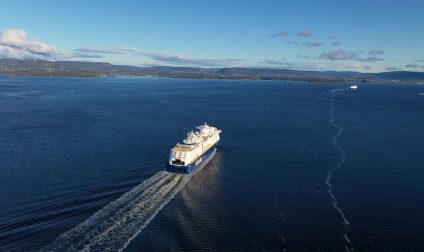
The growing demand for bandwidth across cruise and ferry fleets is driven by more than passenger expectations. Vessels rely on stable, high-capacity internet for everything from booking systems and IoT sensors to cloud apps, real-time diagnostics, and crew support.
For years, the industry looked to space for answers. But increasingly, the most strategic operators are turning their attention to something much closer: the land.
A Different Approach to a Familiar Problem
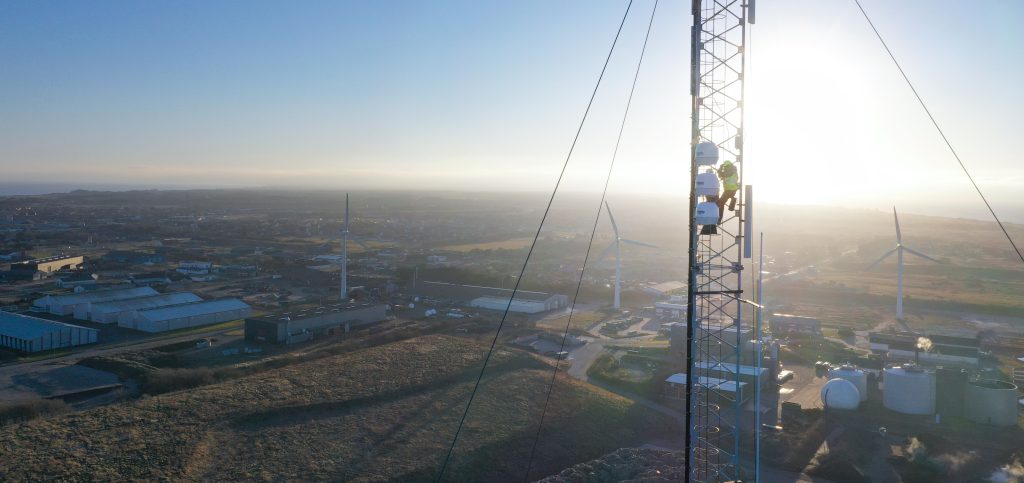
Nowhere Networks has built the world’s largest land-based connectivity network for maritime use. With hundreds of shore-based radio antennas across Europe, covering major ferry routes, ports, and coastlines, it delivers gigabit-class speeds with ultra-low latency and unmatched cost efficiency.
Importantly, the network doesn’t stop at the shoreline: every ship connected via Nowhere Networks is also equipped with proprietary antenna systems, forming part of the company’s self-owned infrastructure. The ships themselves become mobile extensions of the network; tightly integrated, always tracked, and fully managed from shore to sea.
It’s all about using satellites only when you need to.
The core of the system is a hybrid model that combines land-based radio, LTE/5G, and LEO satellite in one seamless platform, managed via proprietary software and onboard systems. Vessels connect automatically to the best available source, with dynamic traffic prioritization built in.
In real terms, this means:
-
Up to 1 Gbit/s downlink and 1 Gbit/s uplink per vessel
-
Latency under 10 ms when within land coverage
-
Data volumes exceeding 20 TB/month per ship, already in use across major fleets
-
No up-front investment because everything is delivered as a managed service, including hardware, software, installation, and 24/7 support
Smart Connectivity Is a Strategic Choice
Companies like Irish Ferries, DFDS, and Stena Line have adopted this model not just for performance but for control, flexibility, and total cost of ownership.
Their priorities are clear:
-
Keep passengers and crew connected without overspending
-
Ensure critical systems always stay online
-
Simplify procurement and vendor management
-
Prepare for increasing demand, without increasing complexity
At the heart of the system is Nowhere Networks’ onboard unit – the Dynamic Connectivity Gateway (DCG). It manages bandwidth in real time, allocating traffic based on usage, type, and available networks. Streaming can be deprioritized when needed; payment systems and IoT can be guaranteed throughput. In port, capacity expands automatically. Far offshore, if needed, the system blends in LEO or LTE with no crew involvement.
A Quiet Shift That’s Gaining Momentum
A land-first model reduces cost per gigabyte by up to 90% compared to satellite-only solutions. It removes the need for long lock-ins and CAPEX-heavy contracts. It scales with fleets, supports flexible business models (like paid Wi-Fi tiers), and offers full visibility across vessels and routes.
And perhaps most importantly: it works.
Nowhere Networks delivers connectivity that starts from the ground up, literally.